I Lava Volcano
- World Famous Hawaii Lava Boat Tours since 2006; Epic lava viewing tour for even most seasoned travelers; Every seat offers front row view to see lava.
- Big Island lava viewing, best ways to view the Kilauea Volcano lava flow; lava boat tours, lava hiking tours, lava helicopter tours. Many different ways to view the.
- Lava is the molten rock expelled by a volcano during an eruption. The resulting rock after solidification and cooling is also called lava. The molten rock is formed.

The return of the lava rocks is a confidential personal service handled by volunteers to give people that can not return the lava rocks in person to Hawaii an. We specialize in a unique Hawaii Volcano Tour experience to see Kilauea Volcano lava flowing into the Pacific Ocean by boat or guided hike.
As a beautiful rainbow blazes across the sky, highly viscous lava flows from a volcanic lava tube in Hawaii on April 4. There are three types of basalt lava flows: pillow, pahoehoe, and a'a. Pillow lavas are volumetrically the most abundant type because they are erupted at. Lava pictures from 'smiling' Hawaiian volcano Jump to media player The Kilauea volcano in Hawaii has erupted, however the volcano appears to be "smiling".
What are the different types of basaltic lava flows and how do they form? However, you have to be very careful to make sure that you are not looking at regular old pahoehoe toes, which of course, indicate dry land. Many of the features that supposedly can be used to tell the difference between the two don't always work. They form from low effusion- rate eruptions of fluid basalt lava. They have a rounder form than pahoehoe toes, mainly because of the ability of water to help buoy them up (gravity doesn't flatten them out so much). Also in contrast to pahoehoe toes, pillow lavas tend to have thicker skins of glass (because they are quenched more quickly), less vesicular skins (because even shallow water pressure is able to prevent bubbles from expanding very much), and generally radial fractures (in contrast to the generally concentric flow banding seen in pahoehoe toes).

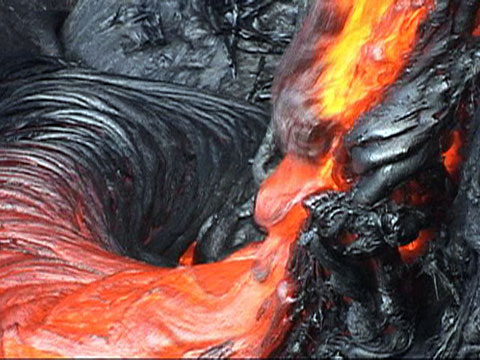
Nevertheless, it is often difficult to tell the two types of lava apart in exposures. The only way to absolutely know that the flows you're looking at are pillow lavas rather than pahoehoe toes, is to find submarine sediments (such as hyaloclastite debris formed from the violent reaction of lava and water) between the pillows. Pillow lavas are also found near the summit of Mauna Kea These pillow lavas were produced by a subglacial eruption that occurred 1. Figure 2. 1. 1. 1 from Porter, 1. Pahoehoe. Pahoehoe is the second most abundant type of lava flow. Pahoehoe lava is characterized by a smooth, billowy, or ropy surface.
Pahoehoe flows tend to be relatively thin, from a few inches to a few feet thick. In map- view the flows tend to be narrow and elongate. Image Credit: Steve Mattox, 1. Aa lava flows tend to be relatively thick compared to pahoehoe flows. During the early episodes of the current eruption of Kilauea volcano, aa flows up to 3. Royal Gardens subdivision at rates as great as 1. Image Credit: R.
Decker/USGS July 0. The A'a / Pahoehoe difference: If lava cools slowly and does not move too fast it forms smooth ropy lava called pahoehoe. Press Play. However, if it cools quickly and moves fast it can tear into clinkery pieces called a'a. Temperature and gases certainly influence whether the lava becomes aa or pahoehoe. Probably the two biggest factors are viscosity and rate of shear strain. Viscosity is just how sticky something is (how much it resists flowing).
An example of rate of shear strain is how quickly or slowly force is applied across a deck of cards. Some factors influencing viscosity or rate of shear strain are listed below: temperature flow velocity and duration gas content flow dimensions lava vesicularity ground slope crystallinity channel configuration Peterson and Tilling (1. If lava slows, cools, and stops in direct response to the corresponding increase in viscosity only, it retains its pahoehoe form.
If lava is forced to continue flowing after a certain critical relationship> between viscosity and rate of shear strain is achieved, the lava changes to aa. Peterson and Tilling called this critical relationship the . The converse is also true. If the viscosity of the lava is high, a relatively low rate of shear strain may achieve the transition threshold, and the lava changes to a'a. People often ask if there is a compositional difference between aa and pahoehoe lava. There is no systematic chemical difference between aa and pahoehoe lava.
Lavas with the identical compositions can form both aa and pahoehoe. Lavas that have slight chemical differences tend to have different temperatures and viscosity's but the critical factor influencing the transition from pahoehoe to aa is the viscosity of the lava. Other lavas: Other types of lavas include block lava, which has a surface of large angular blocks, and rhyolite lava. These two types are associated with lava chemistries other than basalt.
They tend to be very thick (1. What Ails You. Source of Information: Peterson, D.
W., and Tilling, R. I., 1. 98. 0, Transition of basaltic lava from pahoehoe to aa, Kilauea Volcano, Hawaii: field observations and key factors: Journal of Volcanology and Geothermal Research, v.
Lava Ocean Tours - Volcano Lava Tours. LAVA IS NOW ENTERING THE SEA! Embark on a unforgettable journey along East Hawaii’s scenic coastline on a Hawaii Volcano Tour by boat to discover ocean adventure. This open ocean guided boat excursion cruises along the scenic Puna coast to see Hawaii Volcanoes National Park’s lava tubes, volcanic landscapes, and black sand beaches. A one of a kind tour on the Big Island !!!
Volcano Kilauea Status Update (where the lava meets the sea)Episode 6. Kamokuna where a small lava delta has been growing since late March proceeding the January 1, 2. While the US Geological Study and US Coast Guard have recently began implementing new regulations based on land based lava studies.
We do not control the lava, unfortunately! Lava Conditions are ever- changing we see eruption activity from Kilauea Volcano on this volcano tour! This is an open ocean adventure tour.