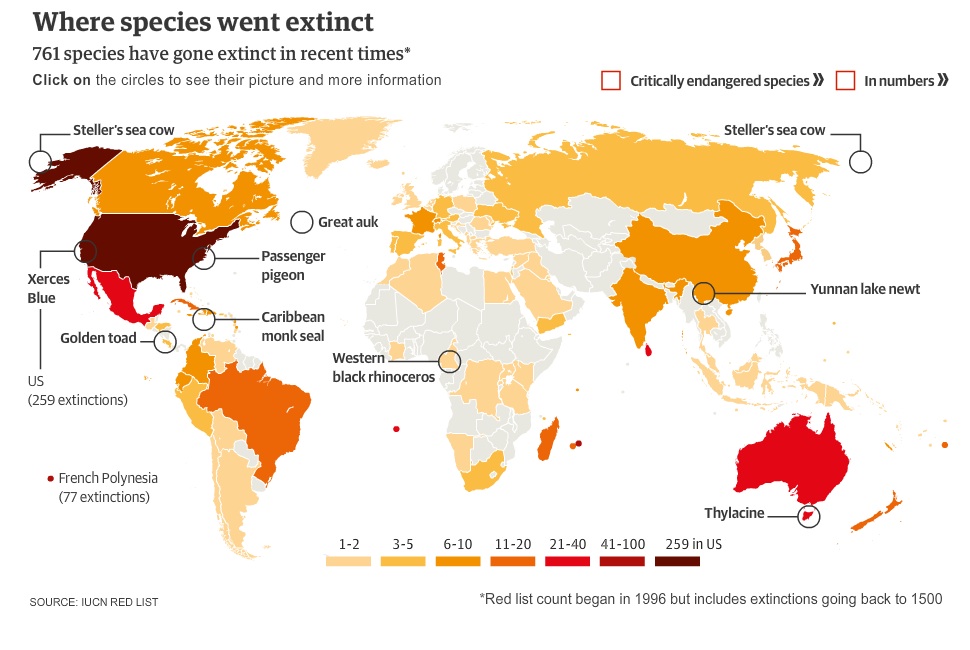
in Biology And Ecology, Extinction Is The End Of An Organism Or Of A Group Of Organisms (taxon), Normally A Species. The Moment Of Extinction Is Generally Considered To Be The Death Of The Last Individual Of The Species, Although The C ' />Today, a sixth mass extinction could be. Extinction is one of the major features of evolution. A species is extinct when no members of the species are still alive. All species become extinct sooner or later. Extinction - When an infection turns most of humanity into rabid zombies, two men (Matthew Fox, Jeffrey Donovan) and a 9-year-old girl (Quinn McColgan). Ex·tinc·tion (. The act of extinguishing: The extinction of the fire took several hours. The condition of being extinguished: mourned.
What Causes Extinction and When Does It Occur? In classical conditioning, this happens when a conditioned stimulus is no longer paired with an unconditioned stimulus.
What could cause a person or animal to stop engaging in a previously conditioned behavior? Extinction is one explanation. In psychology, extinction refers to the.
In operant conditioning, extinction can occur if the trained behavior is no longer reinforced or if the type of reinforcement used is no longer rewarding. In classical conditioning, when a conditioned stimulus is presented alone without an unconditioned stimulus, the conditioned response will eventually cease.
VIDEO
Director Russell Mulcahy takes over for the third chapter in the Resident Evil film franchise, which finds genetically altered Alice (Milla Jovovich) joining forces.
For example, in Pavlov's classic experiment, a dog was conditioned to salivate to the sound of a bell. When the bell was repeatedly presented without the presentation of food, the salivation response eventually became extinct. In operant conditioning, extinction occurs when a response is no longer reinforced following a discriminative stimulus. Skinner described how he first observed this phenomenon.
In this lesson, learn more about extinction in operant. For nine years, Patrick (Matthew Fox), Jack (Jeffrey Donovan) and his daughter Lu (Quinn McColgan) have outlasted the zombie apocalypse by shutting themselves off in. The dominant account of extinction involves associative models. However, there is debate over whether extinction involves simply "unlearning" the unconditional. Extinction of animals and plants. Read scientific research on the dinosaur extinction, future mass extinctions, and endangered species.
A rat was pressing the lever in an experiment on satiation when the pellet dispenser jammed. I was not there at the time, and when I returned I found a beautiful curve. The rat had gone on pressing although no pellets were received. The change was more orderly than the extinction of a salivary reflex in Pavlov's setting, and I was terribly excited. It was a Friday afternoon and there was no one in the laboratory who I could tell. All that weekend I crossed streets with particular care and avoided all unnecessary risks to protect my discovery from loss through my accidental death.
What happens when the researcher stops delivering the food? While extinction will not occur immediately, it will after time. If the rat continues to press the key but does not get the pellet, the behavior will eventually dwindle until is disappears entirely. Conditioned taste aversions can also be affected by extinction. Imagine that you ate some ice cream right before getting sick.
As a result, you developed a taste aversion to ice cream and avoided eating it, even thought it was formerly one of your favorite foods. One way to overcome this reluctance would be to expose yourself to ice cream, even if just the thought of eating it makes you feel a little queasy. You might start by taking just a few small tastes over and over again. As you continue to eat the food without getting sick, you conditioned aversion will eventually diminish. Does the Response Really Disappear? So if the conditioned response is no longer displayed, does that really mean that it is gone forever? In research on classical conditioning, Pavlov found that when extinction occurs, it does not mean that the subject returns to their unconditioned state.
Allowing several hours or even days to elapse after a response has been extinguished can result in spontaneous recovery of the response. Spontaneous recovery refers to the sudden reappearance of a previously extinct response.
In his research on operant conditioning, Skinner discovered that how and when a behavior is reinforced could influence how resistant it was to extinction. He found that a partial schedule of reinforcement (reinforcing a behavior only part of the time) helped reduce the chances of extinction. Rather than reinforcing the behavior each and every time it occurs, the reinforcement is given only after a certain amount of time has elapsed or a certain number of responses have occurred.
This sort of partial schedule results in behavior that is stronger and more resistant to extinction. Factors That May Influence Extinction. A number of factors can influence how resistant a behavior is to extinction.
The strength of the original conditioning can play an important role. The longer the conditioning has taken place and the magnitude of the conditioned response may make the response more resistant to extinction. Behaviors that are very well established may become almost impervious to extinction, and may continue to be displayed even after the reinforcement has been removed altogether. Some research has suggested that habituation may play a role in extinction as well. For example, repeated exposure to a conditioned stimulus may eventually lead you to become habituated.
Because you have become habituated to the conditioned stimulus, you are more likely to ignore it and it is less likely to elicit a response, eventually leading to the extinction of the conditioned behavior. Personality factors might also play a role in extinction. On study found that children who were more anxious were slower to habituate to a sound.
As a result, their fear response to the sound was slower to become extinct than non- anxious children. Sources: Coon, D.
Psychology: A Journey. Cengage Learning; 2. Kramble, S. Psychology of learning behavior. New Delhi: Global Vision Publishing House; 2.
Pavlov, I. Conditioned reflexes: An investigation of the physiological activity of the cerebral cortex. New York: Dover.; 1. Skinner, B. A case history in scientific method. American Psychologist. Skinner, B. The shaping of a behaviorist: Part two of an autobiography. New York: Knopf; 1.