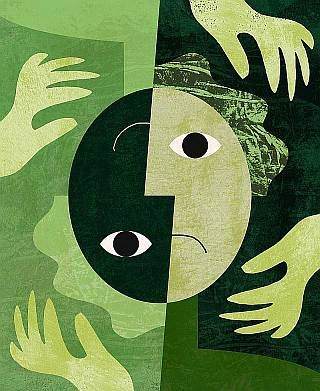
Dissonance
When victims of narcissistic are suffering from Stockholm Syndrome, they are often seen by outsiders as somehow having participated in some bizarre way that seems to support their abuse. However, to understand how the trauma bonding occurs, it is especially relevant to understand what is involved in the decision- making and problem- solving process of the victim. This theory is known as Cognitive Dissonance.
Episode 353: Gift of Doubt with Anthony Magnabosco. Thanks to Anthony for joining us. En psychologie sociale, la dissonance cognitive ou distorsion cognitive au Québec En musique, une dissonance (antonyme de consonance) désigne la discordance d’un ensemble de sons (dans un accord ou un intervalle) produisant une impression d.
If therapists are to understand the behaviour of clients who have been victims of narcissistic abuse, then it is crucial for them to appreciate why the victim combines the two unhealthy conditions of Stockholm Syndrome and Cognitive Dissonance as part of their survival strategy. When these two strategies are in place, the victim firmly believes that their relationship is not only acceptable, but also vital for their survival. They become so enmeshed in the relationship with the abuser, that they feel that their world (mental and emotional) would fall apart if the relationship ended. This explains why they fear those people who attempt to rescue them from their abuser, and how this causes the victim to develop cognitive dissonance and become protective of their abuser. What is Cognitive Dissonance? Cognitive dissonance is a psychological term which describes the uncomfortable tension that results from having two conflicting thoughts at the same time, or from engaging in behavior that conflicts with one’s beliefs (Rational Wiki).
Simply speaking, cognitive dissonance is the discomfort a person experiences whenever they are holding two conflicting ideas simultaneously (i. Shall I wear the red or the blue dress?). Naturally, people do not like the discomfort of conflicting thoughts; this theory proposes that when this happens, people have a motivational drive within them that allows them to rationalize and change their attitudes, beliefs, values and actions, anything that allows them to reduce or dissolve the dissonance they are experiencing (i. Which makes my bum look smallest?) . When it comes to victims of abuse, there are several behaviours that a victim may use for reducing their cognitive dissonance.
An index page listing Values Dissonance content. Tropes are common denominators. Their viewers recognize them, laugh at them or groan at them, but most of us.
For a start they may try to ignore or eliminate it, or they may try to alter its importance, they may even create new cognitions, but most importantly they will try to prevent it from happening in the first place. What part does Cognitive Dissonance play with victims of narcissistic abuse? Victims living in a household where there is narcissistic abuse are living in a torturous war zone, where all forms of power and control are used against them (intimidation; emotional, physical and mental abuse; isolation, economic abuse, sexual abuse, coercion etc.). The threat of abuse is always present, and it usually gets more violent and frequent as time goes on. The controlling narcissistic environment puts the victim in a dependency situation, where they experience an extreme form of helplessness which throws them into panic and chaos. The narcissist creates a perverse form of relationship wherein the victim has no idea of what will happen next (alternating between acts of kindness or aggressive raging).
Post-Decision Dissonance. Explanations > Theories > Post-Decision Dissonance.
This prolonged torturous situation is likely to trigger old negative scripts of the victim’s childhood internal object relations (attachment, separation and individuation). To survive the internal conflict, the victim will have to call on all their internal resources and defense strategies in order to manage their most primitive anxieties of persecution and annihilation. In order to survive, the victim has to find ways of reducing their cognitive dissonance, the strategies they employ may include; justifying things by lying to themselves if need be, regressing into infantile patterns, and bonding with their narcissistic captor.
Most defense mechanisms are fairly unconscious, so the victim is unaware of using them in the moment; all they are intent on is surviving the madness they find themselves in. As you can imagine, these states of mind throw the victim into any number of inner conflicts where defense mechanisms are called for, cognitive dissonance being one. For example, a woman who is abused by her narcissistic spouse will hate the conditions she is living in. However with the real fear of a violent reprisal from her captor if she tried to leave, she will more likely choose to stay put. The cognitive dissonance shows itself through rationalization: On the one hand: she abhors her unhealthy relationship and all the abuse that goes with it; while on the other hand, she tells herself that he only fights with her because he loves and cares for her. This inner dialogue reduced her anxiety, allowing her to bond (Stockholm Syndrome) with her abuser, to the point that she will even protect him from the outside world if people attempt to rescue her or encourage her to leave.
The result is that a massive draining conflict ensues between the person’s emotional self and their rational reasoning self. Their “cognitive dissonance” is a sign of the disharmony the victim is experiencing as a result of two conflicting ideas going on at the same time; i. While experiencing cognitive dissonance they may adopt a pattern of denial, diversion and defensiveness to control their discomfort. In the cognitive dissonance theory, the decision that decides which path the victim will take will be likely to be the path that causes the least emotional stress. In order to reduce the dissonance, the victim will choose the path of least resistance, and their motivational drive will support their beliefs and justify any decision that helps them stay safe.
As you can imagine, the cognitive dissonance can lead to irrational decision making as the person struggles to reconcile these two conflicting beliefs. Researchers suggest that it is actually the cognitive dissonance that causes the victims to choose to stay put with their abuser. Furthermore, in order to support their seemingly irrational decisions to stay put in the abusive relationship, the victim makes heavy investments that almost cements them into the bad relationship forever. There are six types of investment the victim may get embroiled in that helps to reduce their cognitive dissonance: -Emotional Investment: Unable to get out of the relationship due to the fear of what will happen to them, the victim decides that they should stay, and see it through to the bitter end. The victim convinces themselves that “things are not that bad”, especially when the narcissistic abuser shows them acts of kindness. Their trauma bonding is interpreted as love.
They use that love to feel compassion for their narcissistic abuser; they may even make excuses that their abuser suffered so much hurt and pain in their own childhood, that they cannot help the way they are. They convince themselves that by loving their abuser as much as possible they will heal their wounds, and then everything will be alright. They continue in this way, investing so much emotion in the relationship. They shed so many tears, blame themselves for upsetting their abuser, and become responsible for their abusers feelings and behaviour. They worry for their abuser in case they harm someone and end up in jail. They even end up blaming themselves when there is another eruption (“I caused the upset, I should have known better”).
They even go so far as to convince themselves that their abuser is the victim of society, and therefore must be protected from everybody. Social Investment: The biggest social investment the victim makes is to the person nearest to them, their narcissistic abuser.
The narcissist’s superiority will demand that they are the most important one in the relationship, and the victim (in time) will comply with that arrangement. It does not help that society in general has a matter- of- fact attitude toward victims, they do not understand why a victim would stay in such an abusive relationship, let alone protect the abuser. This response can create a further helplessness within the victim, which leaves them feeling isolated and alienated. With a sense of damage to their pride, and deep feelings of shame, the victim begins to avoid further social embarrassment and uncomfortable situations, alienating themselves further with their abuser. Act Like A Lady, Think Like A Man: Remix! Steve Celebrates The Eight-Year Anniversary Of His Book, With Updated Tips!. Isolated, dependent and dis- spirited, the way is paved for more acceptance of the abuser, and the victim stays in the relationship.
They become caught in a cycle with their abuser that involves a sequence of violent episodes, followed by an absence of battering, once again tension building, and finally tension escalating into another violent episode where they get hurt. Around and around it goes, and helplessly the victim loses all hope, so they settle for investing their loyalty there. Family Investments: For a start, a narcissist is preoccupied in self- investment, therefore they expect everybody to pamper to their false self (sadly their true self is in a state of atrophy).
If the narcissist is a spouse, then the partner is going to have to invest heavily in their abuser until they are emotionally, mentally, physically and spiritually bankrupt. The narcissist requires perfect mirroring and stroking continuously, when they don’t get it, they withdraw (this withdrawal is likely to lead to danger for the victim). Step by step the supposed closeness is disappearing, and the victim experiences this as a great loss (and fear), seeing this, the narcissist feels a sense of power and control. In their withdrawal state, the narcissist is going to lose their sense of specialness, power and omnipotence, this makes them very susceptible to narcissistic injury.
When there is narcissistic injury, the terror monster is released, and all of the family is likely to encounter their rage. All of this is going to evoke anxiety on the victimized partner, not just around their own safety, but also for the safety of the children. The narcissist suffers from a chronic evasive pattern that does not change.
Values Dissonance - TV Tropes. Tropes are common denominators. Their viewers recognize them, laugh at them or groan at them, but most of us can guess where they're coming from—specifically, what cultural values are embodied in the trope. They're fine on their home turf, where everyone understands them and knows what value system they're based on.
When that trope makes the trip to another country however, it gets seasick on the way over, arriving at port looking distinctly disheveled and finding itself among strangers who have no idea what it's talking about. Even in countries that speak the same language, values can be different. The UK and the USA, for example, share a language and are regarded as culturally similar to one another.. The UK also has no death penalty, while the US does for federal offenses and offenses against about half the states. This leads to some fundamental differences in the way the legal system is perceived, even between two countries that are alike in many other ways. A show where the death penalty for a criminal is a good ending in a state that accepts such a measure may not be as accepted as such in a state that frowns on execution.
With the multicultural nature of many places, sometimes a trope only has to go down the street to become completely unrecognizable. Differing religions, backgrounds or life experiences can mean that a person's view of a trope differs from the .
The world being the dynamic and evolving place that it is, some aspects of the media don't quite manage to keep pace with the time, and become the . Compare Moral Dissonance, where the show breaks its own morals. Also see Germans Love David Hasselhoff, in which it's critical acclaim rather than moral values that is on the line. Also see Fair for Its Day, in which the work actually has less values dissonance than its contemporaries.
See Culture Clash and Innocent Bigot for when this happens in- story and Deliberate Values Dissonance for when the author is doing it on purpose. Please list that trope instead of invoking this trope on any works that do so. Also see Have a Gay Old Time and Get Thee to a Nunnery, where dialogue is interpreted differently due to this. Has similarity to Good Flaws, Bad Flaws.
Also see The Generation Gap, which is a subtrope encompassing differing values among generations (for instance, between the World War II and Baby Boomer generations). Blue and Orange Morality is this trope taken Up to Eleven. Contrast Values Resonance. Can sometimes result in Misplaced Nationalism.
And of course, it's likely to result in the exclamation, Dude, Not Funny! An example of Values Dissonance between the United Kingdom and the US would be the use of blackface imagery, which formed the centrepiece of The BBC's Black and White Minstrel Show until the 1.
Blackface was/is also used in other countries, such as Japan, The BENELUX, and Australia, where it does not have the same cultural stigma or even origin. You may well encounter a custom or belief on this page that you don't think is dissonant at all; you might even be inclined to vehemently defend it. Indeed, concepts of right or wrong or even of what is . Across every period of Earth's history, just about anything has been or can potentially be justified, or at least rationalized. So if you see a value here you don't find dissonant at all, please refrain from adding your own interpretation.